

Remplissage Procedure in Lincoln & Omaha, NE
The remplissage procedure is a minimally invasive arthroscopic shoulder surgery used to treat recurrent anterior shoulder instability associated with a Hill-Sachs lesion. A Hill-Sachs lesion is a compression fracture or defect in the humeral head (ball of the shoulder) that occurs when the shoulder repeatedly dislocates. This defect can “engage” with the socket and increase the risk of further dislocations. The remplissage procedure helps prevent instability by filling this defect with tendon tissue from the rotator cuff, effectively limiting the abnormal movement that leads to dislocation. It is often performed alongside a Bankart repair for comprehensive shoulder stabilization.
Matthew Byington, DO provides evaluation and treatment for complex shoulder instability in Lincoln and Omaha, including arthroscopic remplissage procedures.
What Is Shoulder Instability?
Shoulder instability occurs when the ball of the upper arm bone (humerus) repeatedly slips out of the socket (glenoid). This can be partial (subluxation) or complete dislocation and often leads to ongoing pain, weakness, and loss of confidence in shoulder movement.
What Is a Hill-Sachs Lesion?
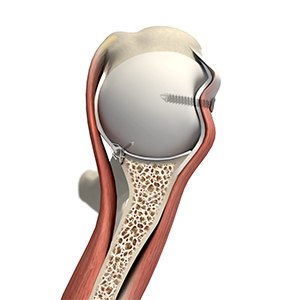
A Hill-Sachs lesion is a dent or compression injury on the back of the humeral head caused by repeated shoulder dislocations. When this defect “engages” with the front of the socket, it can trigger further instability and recurrent dislocations.
Causes of Shoulder Instability and Hill-Sachs Lesions
Common causes include:
- Traumatic shoulder dislocation
- Sports injuries (contact or overhead sports)
- Repetitive instability episodes
- Falls onto an outstretched arm
- Labral or ligament injuries
Symptoms of Shoulder Instability
Patients may experience:
- Recurrent shoulder dislocations or subluxations
- Shoulder pain, especially with overhead motion
- Feeling of the shoulder slipping out
- Weakness or instability during activity
- Limited range of motion
- Anxiety during sports or lifting movements
When Is Remplissage Recommended?
The remplissage procedure may be recommended for:
- Recurrent anterior shoulder instability
- Presence of a significant Hill-Sachs lesion
- “Engaging” Hill-Sachs defect causing repeated dislocations
- Failure of non-surgical treatment
- Combined instability treated with Bankart repair

Matthew Byington, DO Board Certified Orthopaedic Surgeon
Dr. Matthew Byington is a board certified Orthopedic Surgeon, specializing in minimally invasive arthroscopic techniques and sports medicine. He specializes in Shoulder, Knee and Elbow conditions, although he treats all orthopedic conditions.
How the Remplissage Procedure Is Performed
Remplissage is performed arthroscopically using small incisions and a camera-guided approach.
Surgical steps may include:
- Small incisions (portals) around the shoulder
- Insertion of an arthroscope for visualization
- Identification of the Hill-Sachs defect
- Placement of suture anchors into the humeral head defect
- Attachment of the infraspinatus tendon and posterior capsule into the defect
- “Filling” the defect to prevent engagement with the glenoid
- Often combined with Bankart repair for added stability
- Closure of incisions with sutures or steri-strips
This technique limits abnormal humeral head motion and reduces dislocation risk.
Recovery After Remplissage
Recovery is gradual and includes:
- Sling immobilization for several weeks
- Pain and inflammation control
- Early passive motion exercises under guidance
- Structured physical therapy program
- Gradual strengthening of rotator cuff and shoulder stabilizers
- Return to sports after full rehabilitation (typically several months)
Recovery timelines vary depending on associated procedures.
Benefits of the Remplissage Procedure
- Reduced risk of recurrent shoulder dislocation
- Improved joint stability
- Minimally invasive arthroscopic approach
- Can be combined with Bankart repair
- Strong long-term outcomes in selected patients
- Improved confidence in shoulder movement
Risks & Complications
Possible risks include:
- Shoulder stiffness
- Loss of external rotation
- Recurrent instability
- Infection
- Nerve or blood vessel injury (rare)
- Incomplete symptom relief
- Tendon irritation or weakness
Why Choose Matthew Byington, DO
Matthew Byington, DO specializes in advanced arthroscopic shoulder stabilization procedures, including remplissage for complex instability cases with Hill-Sachs lesions. His treatment approach focuses on restoring stability, protecting shoulder function, and helping patients safely return to sports and daily activities.
Each treatment plan is customized based on imaging findings, instability severity, and activity goals.
Frequently Asked Questions
What does “remplissage” mean?
It means “to fill,” referring to filling the humeral defect with tendon tissue.
Is remplissage done alone?
It is often performed with a Bankart repair.
Will I lose shoulder motion?
There may be a slight reduction in external rotation in some cases.
How long is recovery?
Most patients recover over several months with rehab.
Can I return to sports?
Yes, many patients return after full rehabilitation.
Restore Shoulder Stability & Reduce Dislocations
If recurrent shoulder dislocations or a Hill-Sachs lesion is affecting your activity level, the remplissage procedure may help restore stability and prevent future injury.
Schedule a consultation with Matthew Byington, DO to explore your treatment options.