

Latarjet Procedure in Lincoln & Omaha, NE
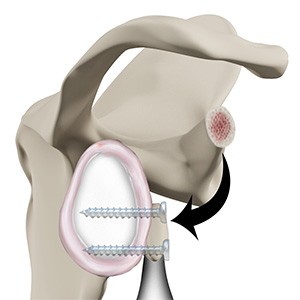
The Latarjet procedure is a surgical treatment for recurrent shoulder instability, especially in patients with significant bone loss from the socket (glenoid) or a bony Bankart lesion. Shoulder instability occurs when the humeral head (ball) repeatedly slips out of the glenoid (socket), often due to trauma or repeated dislocations. In the Latarjet procedure, a small piece of bone with an attached tendon (coracoid process) is transferred to the front of the shoulder socket to restore stability and prevent further dislocations. This procedure is often recommended when soft-tissue repairs alone are not sufficient.
Matthew Byington, DO provides evaluation and treatment for complex shoulder instability in Lincoln and Omaha, including Latarjet stabilization surgery.
What Is Shoulder Instability?
The shoulder is a ball-and-socket joint designed for wide motion, but this flexibility makes it prone to instability. Stability is normally maintained by:
- The labrum (cartilage rim of the socket)
- Joint capsule and ligaments
- Surrounding muscles and tendons
When these structures are damaged, the shoulder may dislocate repeatedly.
What Is a Bankart Lesion?
A Bankart lesion is a tear of the labrum, often caused by anterior (front) shoulder dislocation. In more severe cases, the injury includes a fragment of bone, known as a bony Bankart lesion, which can significantly reduce shoulder stability.
Causes of Shoulder Instability
Common causes include:
- Traumatic shoulder dislocation
- Sports injuries (contact or overhead sports)
- Repetitive instability episodes
- Falls onto an outstretched arm
- Ligament or labral injury
Symptoms of Shoulder Instability
Patients may experience:
- Recurrent shoulder dislocations
- Feeling of the shoulder “slipping out”
- Pain with movement or activity
- Weakness in the shoulder
- Loss of confidence during sports or lifting
- Limited range of motion
When Is the Latarjet Procedure Recommended?
The Latarjet procedure may be recommended for:
- Recurrent anterior shoulder dislocations
- Bony Bankart lesions or significant bone loss
- Failed previous labral repair
- High-risk athletes (contact sports)
- Severe instability not corrected by soft-tissue surgery
Matthew Byington, DO Board Certified Orthopaedic Surgeon
Dr. Matthew Byington is a board certified Orthopedic Surgeon, specializing in minimally invasive arthroscopic techniques and sports medicine. He specializes in Shoulder, Knee and Elbow conditions, although he treats all orthopedic conditions.
How the Latarjet Procedure Is Performed
The Latarjet procedure is performed under general anesthesia, typically in a beach-chair position.
Surgical steps may include:
- Small incision over the front of the shoulder
- Exposure of the coracoid process (small bone of the shoulder blade)
- Detachment of the coracoid with attached tendon
- Preparation of the bone graft and drilling of fixation holes
- Splitting of the subscapularis muscle fibers
- Exposure of the front of the glenoid (socket)
- Placement of the coracoid graft onto the glenoid rim
- Fixation using surgical screws
- Creation of a “sling effect” using the attached tendon for added stability
- Closure of the incision with sutures
This reconstruction increases socket stability and prevents dislocation.
Recovery After Latarjet Surgery
Recovery is structured and gradual:
- Sling immobilization for 3–6 weeks
- Pain control with medications and ice therapy
- Early finger and wrist movements immediately after surgery
- Passive range-of-motion exercises starting early
- Physical therapy for strengthening and stability
- Gradual return to normal activity after approximately 3 months
- Return to sports typically after full rehabilitation
Adherence to rehabilitation is critical for long-term stability.
Benefits of the Latarjet Procedure
- Strong and reliable shoulder stability
- Reduced risk of recurrent dislocation
- Effective in patients with bone loss
- High success rate in active individuals and athletes
- Improved ability to return to sports
- Long-term joint stability
Risks & Complications
Possible risks include:
- Bleeding or hematoma formation
- Infection
- Coracoid bone non-union or fracture
- Shoulder stiffness
- Hardware irritation or screw issues
- Recurrent instability (rare)
- Nerve or blood vessel injury (rare)
Why Choose Matthew Byington, DO
Matthew Byington, DO specializes in advanced shoulder stabilization procedures, including the Latarjet technique for complex and recurrent instability cases. His approach focuses on restoring structural stability, preventing future dislocations, and helping patients return safely to athletic and daily activities.
Treatment is individualized based on bone loss, activity level, and prior surgical history.
Frequently Asked Questions
Why is the Latarjet procedure needed?
It is used when there is significant bone loss or repeated shoulder dislocations.
Is it better than a standard labral repair?
In cases with bone loss or failed repair, it is often more effective.
How long is recovery?
Most patients recover over several months with structured rehabilitation.
Will I regain full shoulder strength?
Strength improves significantly, especially stability, though full recovery varies.
Can athletes return to sports?
Yes, many return to contact and overhead sports after rehab.
Restore Shoulder Stability & Prevent Dislocations
If recurrent shoulder dislocations or instability are affecting your quality of life or athletic performance, the Latarjet procedure may provide a durable solution.
Schedule a consultation with Matthew Byington, DO to discuss your treatment options.